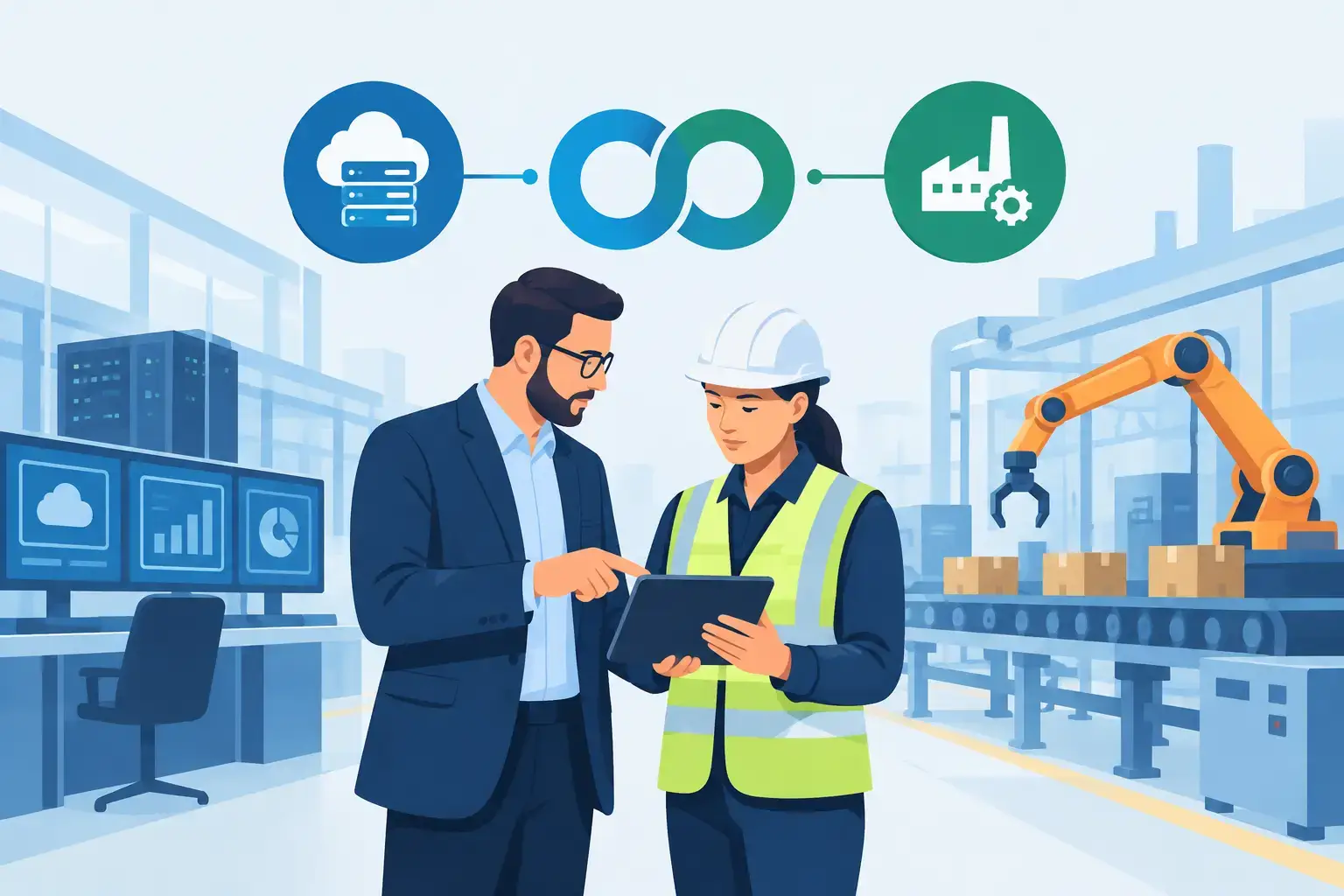
A plant-floor integration issue can look minor in a project status meeting and still stop production at go-live. A machine may continue producing parts while the MES cannot report completion. Inventory can move physically but remain unavailable in ERP. Quality data can exist in a historian yet never reach the release process. This is the operating reality IT OT convergence consultants must understand before they recommend architecture, systems, or talent.
For manufacturers, IT/OT convergence is not a technology trend to pursue for its own sake. It is the practical work of connecting enterprise platforms with the systems that run production, warehouse activity, quality, maintenance, and industrial equipment. The stakes rise quickly during an SAP S/4HANA migration, Oracle Cloud Fusion deployment, MES modernization, or plant integration program. A design that is technically correct but operationally unworkable creates delays, workarounds, and risk long after the project team has moved on.
What IT/OT Convergence Actually Requires
IT typically owns enterprise applications, identity, data platforms, cloud environments, integration tooling, and corporate cybersecurity controls. OT operates closer to physical processes: PLCs, SCADA, HMIs, industrial networks, historians, plant-floor devices, controls engineering, and production workflows. The boundary is not absolute, but the incentives and failure modes are different.
IT teams are often measured on availability, standardization, security, and enterprise-scale data governance. OT teams are measured on throughput, safety, product quality, equipment uptime, and the ability to recover when something fails in the middle of a production run. A plant cannot pause a critical batch simply because an enterprise patch window has arrived.
Convergence work succeeds when those realities are designed into the program. It requires agreement on data ownership, network segmentation, identity access, exception handling, support escalation, and the sequence in which transactions move between the plant and enterprise platforms. It also requires leaders who can translate between controls engineers, manufacturing operations, cybersecurity, integration architects, ERP process owners, and program management.
That translation is where a generic enterprise consultant often falls short. Knowing cloud integration patterns or ERP master data is useful. Knowing what happens when an interface fails during shift change, when a quality hold is applied, or when a line operates in degraded mode is what makes the advice credible.
Where IT OT Convergence Consultants Create Value
The strongest consultants do not arrive with a predetermined integration diagram. They start with the manufacturing process and identify where information must be accurate, timely, secure, and recoverable. That can include production orders flowing from ERP into MES, material consumption returning to inventory, serialized genealogy records, electronic batch records, warehouse confirmations, or asset and maintenance data.
Their value is most visible in four areas.
First, they establish a workable architecture across plant and enterprise environments. This includes deciding where point-to-point connections are acceptable, where APIs or an integration platform are necessary, and where an edge layer is needed to protect plant operations from cloud or network interruptions. The right answer depends on process criticality, latency requirements, site maturity, and the existing technology estate. Standardization matters, but forcing every plant into the same pattern can create unnecessary disruption.
Second, they expose operational exceptions before testing begins. A happy-path transaction is rarely the challenge. The difficult questions involve partial production reporting, rejected materials, rework, downtime, offline equipment, manual overrides, and late-arriving data. If the team cannot explain how these conditions will be handled, it is not ready for integrated testing.
Third, they help security teams apply controls without compromising safety or uptime. OT security cannot be treated as a lighter version of corporate IT security. Legacy devices may not support modern agents or frequent patching. Vendor remote access may be necessary but poorly governed. Segmentation, asset visibility, privileged access, and incident response must be designed around the production environment, not copied from a corporate endpoint standard.
Fourth, they clarify operating ownership after go-live. Many programs define project responsibilities but leave support ambiguous. When an interface fails at 2:00 a.m., who triages it? Who owns the master data defect? Who can authorize a manual recovery? The technical design and the support model must be developed together.
The Questions That Separate Delivery Experience From Theory
Manufacturers should evaluate IT OT convergence consultants against the program conditions they will actually face. Broad claims of IIoT, Industry 4.0, cloud, or automation experience are not enough. The evaluation should surface whether a consultant has delivered under production constraints.
Ask which ERP, MES, WMS, historian, industrial connectivity, and integration technologies they have worked with in manufacturing settings. Ask whether they have supported cutover, hypercare, site rollout, and incident resolution, not only strategy or design workshops. Ask how they handle store-and-forward requirements, reconciliation after outages, and transaction sequencing when equipment is unavailable.
Equally important, ask for the specific decisions they made and the trade-offs involved. A qualified consultant can explain why a real-time integration was justified in one process but avoided in another, why a site required local buffering, or why a standard enterprise identity model needed adaptation for shared plant-floor workstations. They should be candid about the limitations of the installed base and the risks that cannot be eliminated before go-live.
This is also why role definition matters. An OT cybersecurity architect, MES integration lead, controls-to-cloud engineer, ERP manufacturing solution architect, and enterprise integration architect may all contribute to convergence. They are not interchangeable. Hiring a strong technical generalist for a role that requires direct plant systems experience often shifts the learning curve into the most expensive stage of the program.
Build the Team Around Decisions, Not Job Titles
A convergence program rarely needs a large standalone team. It needs the right expertise at the points where decisions can alter scope, risk, or production readiness. For an S/4HANA or Oracle Cloud program, that may mean an integration lead with manufacturing transaction depth, an MES architect with proven deployment experience, an OT security specialist, and site-level resources who understand the equipment and operating procedures.
The balance changes by program. A greenfield facility may prioritize network architecture, equipment connectivity standards, and security from the start. A brownfield modernization may demand more attention to legacy protocols, undocumented interfaces, downtime limitations, and plant-by-plant variation. A regulated manufacturer may require deeper validation, audit trails, and electronic records expertise. There is no credible one-size-fits-all convergence blueprint.
Program leaders should also distinguish between advisory capacity and delivery capacity. A consultant can define a target-state model without being the person who can troubleshoot a failed MES-to-ERP confirmation during mock cutover. Both profiles can be valuable, but the delivery plan must make the distinction explicit. High-stakes programs need people who can move from architecture discussion to production issue resolution without losing context.
For critical hires, Maxary assesses candidates against the actual technology stack, manufacturing process, program phase, and go-live exposure required for the role. That is a different standard from forwarding resumes based on overlapping keywords. It gives transformation leaders visibility into where a candidate has direct delivery evidence and where the risk remains.
Treat Talent Qualification as a Program Control
Convergence failures are often framed as architecture failures. Some are. But many begin as qualification failures: the integration lead has enterprise experience but no plant-floor deployment history; the OT specialist understands controls but cannot work through ERP transaction impacts; the project manager has led software implementations but has never planned around production windows.
The remedy is not a longer list of certifications. It is a tighter qualification process. Define the decisions the person must own, the systems they must connect, the manufacturing environments they must understand, and the milestones they must have previously supported. Then test for evidence. A candidate should be able to describe the production process, integration failure scenarios, cutover dependencies, and recovery actions in concrete terms.
This rigor matters most when the schedule is compressed. A fast shortlist is useful only when every person on it can be evaluated against the realities of the program. Otherwise, interview time becomes a substitute for screening, and the organization discovers capability gaps after a critical role has already been filled.
Start With the Operating Constraint
The most productive convergence conversations do not begin with platforms. They begin with the production event that cannot fail: a batch release, a line changeover, a material issue, a traceability record, a warehouse handoff, or a safety-related control action. From there, the team can define data flow, availability requirements, security controls, ownership, and the talent needed to deliver it.
That approach keeps IT/OT convergence grounded in its real purpose: protecting the conditions under which manufacturing can keep operating while the technology foundation changes beneath it.