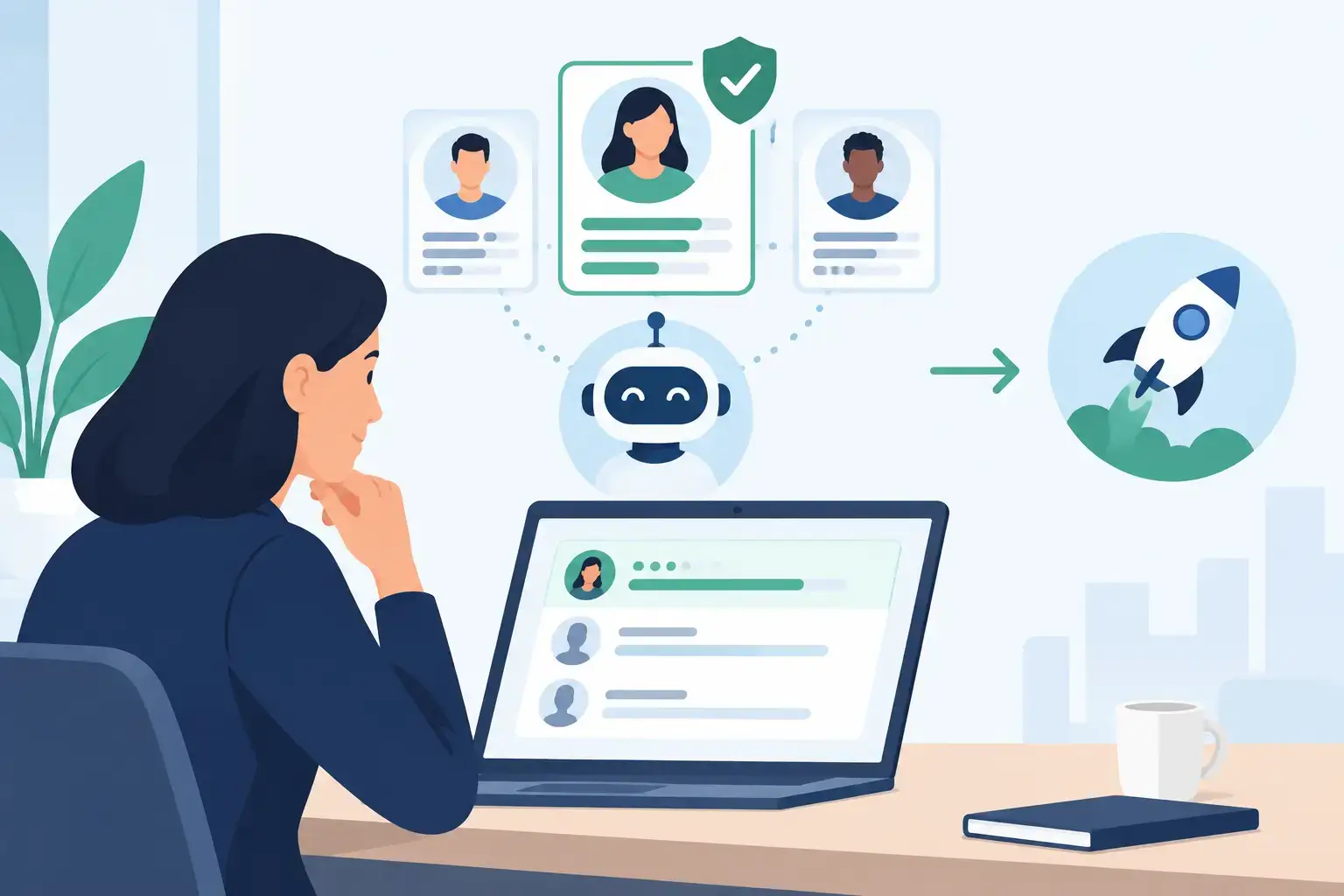
A delayed ERP hire rarely looks like a staffing problem at first. It shows up as an integration backlog, an unresolved master data decision, a plant cutover risk, or a program leader carrying work that should already be owned. AI candidate scoring for recruiters can reduce the time spent sorting applications, but it cannot treat a manufacturing transformation role like a generic IT requisition.
For SAP S/4HANA, Oracle Cloud Fusion, MES, WMS, and IT/OT programs, the central question is not whether a candidate has the right terms on a resume. It is whether they have delivered in conditions that resemble the program at hand: a multi-plant rollout, a compressed cutover, a difficult integration landscape, regulated operations, or an organization moving from legacy processes to a new operating model.
The right use of AI is to make qualification more disciplined and more visible. The wrong use is to automate confidence where evidence is thin.
Where AI candidate scoring helps recruiters
Recruiters working on high-stakes transformation roles face an unhelpful volume problem. A search for an SAP PP lead, Oracle Cloud SCM architect, or MES engineer may produce candidates with overlapping product names but radically different delivery histories. Some have supported systems after go-live. Others have owned design decisions, managed plant readiness, resolved integration failures, or led cutovers under real operating pressure.
AI scoring can process that initial complexity faster than manual resume review alone. It can identify stated experience, normalize job titles, distinguish related technologies, flag missing evidence, and compare a profile against a role-specific scorecard. Used well, it gives the recruiter a more reliable starting point and creates a consistent record of why a person advanced or did not.
That consistency matters when a search involves multiple stakeholders. A program director may prioritize prior S/4HANA conversion experience. A manufacturing technology leader may need evidence of plant-floor integration. HR may need confirmation of location, work authorization, compensation alignment, and leadership scope. A structured scoring model keeps these requirements from becoming scattered opinions across email threads and interview notes.
Speed is valuable, but only when it improves the quality of the shortlist. A 48-hour shortlist has little value if every candidate still requires the hiring team to determine whether they have ever worked through the conditions that make the role difficult.
AI candidate scoring for recruiters needs role-specific evidence
A scoring model is only as credible as the criteria behind it. Generic talent platforms often overweight what is easiest to extract: years of experience, keyword density, title similarity, education, and employer names. Those signals can be useful, but they do not establish delivery readiness.
Consider an SAP S/4HANA manufacturing role. “SAP S/4HANA experience” is not a meaningful qualification by itself. A program may need a functional lead who has managed fit-to-standard decisions across discrete manufacturing plants, coordinated with MES and EDI teams, and supported cutover readiness. Another may require a technical integration leader who understands SAP Integration Suite, legacy middleware, shop-floor interfaces, and the downstream impact of message failures.
Those are different roles, and the evidence needed to assess them is different. The same is true for Oracle Cloud Fusion. An Oracle Cloud SCM candidate who configured inventory workflows is not automatically prepared to lead a complex manufacturing deployment involving procurement, planning, warehouse operations, integrations, data conversion, and change across multiple facilities.
A defensible scorecard should examine more than platform familiarity. For critical enterprise technology roles, criteria often include:
- Direct experience with the target platform, module, and version
- Manufacturing operating context, including plant, warehouse, quality, or supply chain exposure
- Program phase experience, from discovery and design through testing, cutover, hypercare, and optimization
- Integration depth across ERP, MES, WMS, EDI, cloud, and legacy systems
- Scope of ownership, including decisions made, teams led, and risks managed
- Evidence of delivery under comparable timeline, complexity, and stakeholder conditions
This is where AI should support disciplined comparison rather than replace it. The model can surface the evidence quickly. A qualified reviewer must still determine whether the evidence is credible, comparable, and relevant to the program's actual risk.
Resume similarity is not implementation readiness
The most common failure in automated scoring is confusing similarity with suitability. Two resumes may contain the same technologies and job titles while representing entirely different levels of responsibility.
One candidate may list Oracle OIC because they monitored integrations after deployment. Another may have designed integration patterns, handled exception management, coordinated business testing, and stabilized interfaces before go-live. An algorithm trained primarily on historical hiring outcomes may score both profiles favorably if the underlying data does not capture the distinction.
Historical data introduces another concern. If past hiring decisions favored familiar employers, conventional career paths, or a narrow definition of experience, an automated model can repeat those preferences at scale. That is not only a fairness issue. It can also cause a program to miss candidates with highly relevant delivery experience from a less obvious background.
Recruiting leaders should ask a simple question of every score: what evidence produced it? If the answer is a vague match percentage, the score is not ready to influence a high-consequence decision. If the answer identifies relevant implementations, responsibilities, program phases, and gaps, it becomes useful input for human review.
Build scoring around program risk, not just job descriptions
Job descriptions tend to describe responsibilities. Strong scoring models also identify failure points.
For example, an MES modernization search may need an engineer who can configure a platform. But if the client is integrating production equipment, ERP transactions, quality systems, and reporting across active plants, the larger risk may be interface reliability and operational disruption. The scoring model should therefore distinguish between basic MES exposure and experience with production deployment, equipment connectivity, validation, support models, and plant acceptance.
The same principle applies to ERP leadership. A candidate with broad SAP experience may be an excellent fit for steady-state support but a poor fit for a conversion program entering data migration, mock cutover, and business readiness. Scorecards should reflect the stage of the program, not merely the name of the technology.
This requires a better intake process. Before scoring begins, recruiters and hiring leaders need agreement on the nonnegotiables, the preferred evidence, the risks that cannot be absorbed, and the trade-offs the program will accept. A role may require deep manufacturing experience but allow flexibility on a specific middleware tool. Another may require a rare technical capability and accept a candidate with less leadership scale. AI cannot make those trade-offs without clear direction.
Practitioner validation is the control point
The final safeguard is practitioner review by people who understand the technology and the operating environment. They can test whether a candidate's claimed experience holds together, ask where they were accountable, and recognize the difference between participating in a project and carrying a workstream through go-live.
At Maxary, VeriTalent.ai evaluates more than 40 role-specific criteria before practitioner validation. That sequence matters. AI accelerates evidence collection and comparison; experienced evaluators determine whether the candidate can perform in the conditions the client faces.
A useful validation conversation is not a generic technical quiz. It examines delivery facts: what decisions the person owned, how they handled a failed integration, what changed during cutover, which stakeholders resisted a process change, and what they would do differently on the next implementation. Specific answers reveal implementation depth. General answers reveal risk.
Measure the scoring system by delivery outcomes
Recruiting teams should not judge AI scoring solely by time saved per requisition. Faster screening is worthwhile, but it is not the business outcome. The better measures are shortlist quality, interview-to-offer conversion, time to a credible shortlist, candidate retention through critical milestones, and feedback from program leaders after the hire begins.
Review false positives closely. If highly scored candidates repeatedly fail practitioner assessment or hiring-manager interviews, the model is rewarding the wrong signals. Review false negatives as well. If practitioners consistently identify strong candidates that the model ranks low, the criteria may be too narrow or the underlying data may be incomplete.
There is no single ideal balance between automation and review. A repeatable role with clear requirements can support more automated triage. A transformation leadership role, a difficult integration position, or a pre-go-live hire requires a much higher level of human scrutiny. The closer a role is to a costly program milestone, the less acceptable it is to rely on a resume score alone.
The practical standard is straightforward: use AI to remove administrative drag, expose relevant evidence, and make assessments more consistent. Then hold the final decision to the standard that matters most - whether this person has demonstrated they can help the program reach go-live without creating new risk.